Starting any building project, big or small, can feel like a huge undertaking, especially in a city as busy as Auckland. This guide is designed to be your roadmap, helping you find a reliable, skilled, and professional team. We’ll walk you through exactly how to find the right building contractors in Auckland to bring your vision to life, without the usual stress.
Finding Your Ideal Auckland Building Contractor
Embarking on a new build, a renovation, or even a major repair is a significant investment. You’re putting your time, money, and a whole lot of trust on the line. The success of your project really boils down to the quality and professionalism of the contractor you choose. For many Auckland homeowners, the real challenge is cutting through the noise to find a partner who isn't just skilled, but also completely dependable and transparent.
This is about more than just gathering a few quotes. It's about getting to grips with the local building environment, from the legal must-haves to the realities of managing a project on the ground. Think of it as assembling an expert team for a critical mission. You need people who know the terrain—in this case, Auckland’s specific building codes and council processes—and have a proven track record.
Navigating the Auckland Construction Scene
Auckland is the absolute powerhouse of New Zealand’s construction industry. The city is home to a massive 11,871 building construction businesses, making up almost 42% of the country's entire sector. With a national construction workforce of 308,500 people, you'd think finding a good builder would be easy.
But that sheer volume is exactly why doing your homework is so important. A wrong choice can lead to costly mistakes and painful delays. This is where specialist teams with proven credentials, like us at Reports and Repairs, offer real value with our LBP-certified services and a flawless rating on NoCowboys. For a deeper dive, you can explore more data on the national construction landscape in MBIE's detailed sector report.
This guide is here to give you a clear advantage. We'll break down the essential first steps you need to take to protect your investment and ensure your project runs smoothly from day one.
A great building project rests on a foundation of clear communication, verified credentials, and mutual trust. Rushing the hiring process is the single most common and costly mistake a homeowner can make.
Your Roadmap to a Successful Project
We want to arm you with the knowledge to move from feeling anxious about your project to taking confident action. Here’s what this guide will cover to help you find the best building contractors in Auckland for your job:
- Understanding Licensing: We’ll demystify the Licensed Building Practitioner (LBP) scheme and explain why it’s a non-negotiable for most types of work.
- Council Consents: A straightforward look at the Auckland Council consent process and figuring out when you actually need one.
- Effective Budgeting: How to plan your finances realistically for the Auckland market so there are no nasty surprises down the track.
- Vetting Professionals: An actionable checklist for checking credentials, following up on references, and reviewing past projects.
By the time you're done with this guide, you’ll have a practical framework for hiring with confidence, setting the stage for a successful and far less stressful build.
Navigating LBP Rules and Council Consents
Before you even think about hiring building contractors in Auckland, you need to get your head around two sets of rules that shape nearly every project: the Licensed Building Practitioner (LBP) scheme and Auckland Council building consents. Think of them as the official rulebook for building safely and legally in our city. Getting this right from the start is your best protection against shoddy work, expensive delays, and a project that won't stand the test of time.
Let’s break it down. The LBP scheme is basically a driver’s licence for your builder. It's a government programme that officially confirms a builder has the right skills, knowledge, and experience for the job. They don't just hand these licences out—builders have to be assessed and prove they're competent to earn and maintain their LBP status.
Why Your Contractor Must Be an LBP
The LBP scheme is tied directly to what’s called Restricted Building Work (RBW). This isn't just jargon; it’s a specific category of work that’s crucial for your home’s structural strength and weathertightness. If your project involves RBW—and many do—the law says it must be done or supervised by a Licensed Building Practitioner. No exceptions.
So, what kind of work are we talking about? RBW typically includes:
- Foundations and Subfloor Framing: The very base your home stands on.
- Structural Walls and Beams: Anything holding the house up.
- Roofs and Cladding: The protective shell that keeps the weather out.
- Waterproofing for Wet Areas: Think bathrooms, laundries, and tiled decks where leaks can cause serious damage.
Here’s the bottom line: hiring someone without an LBP licence for Restricted Building Work is illegal. It can also void your home insurance and leave you without any official record of accountability if things go wrong, creating a massive headache when you try to sell.
This simple flowchart lays out the non-negotiable steps every homeowner should take.
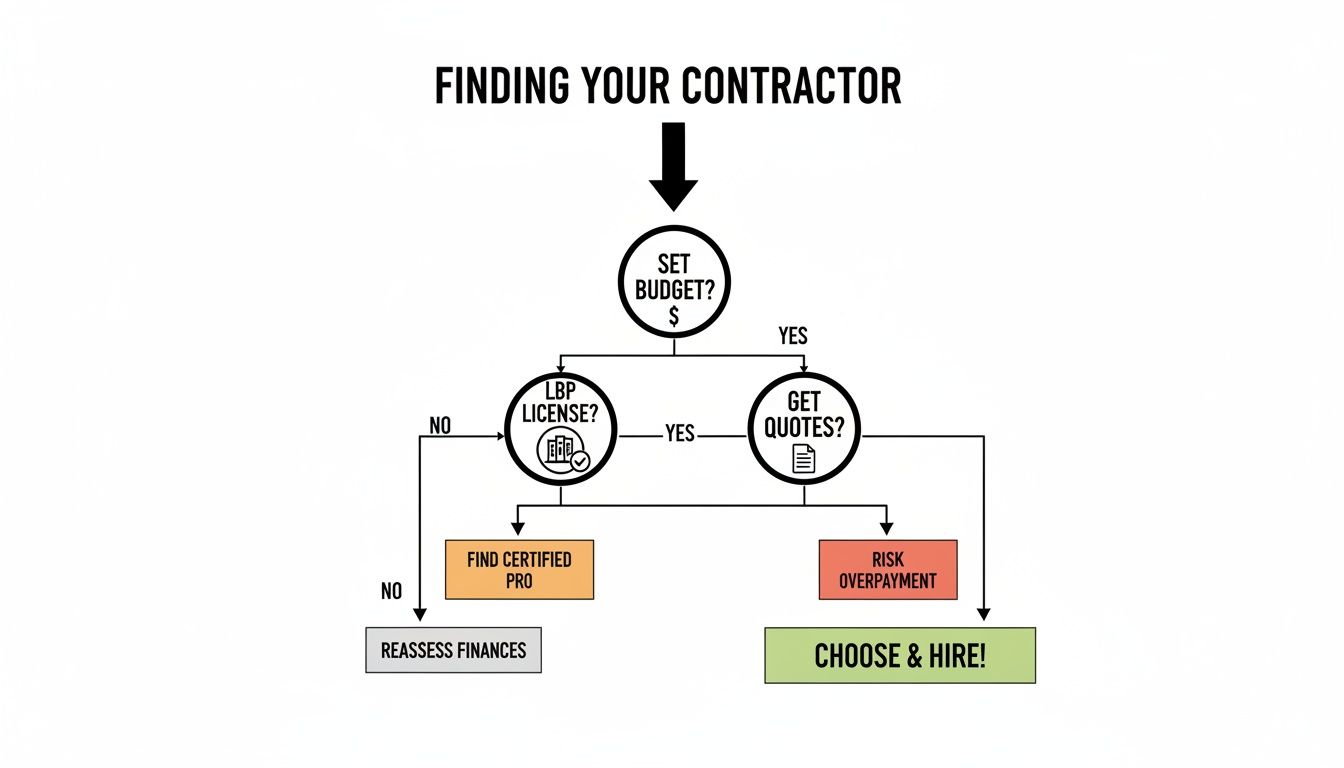
As you can see, checking a builder's LBP credentials isn't just a suggestion—it's a critical step right in the middle of the process, before you even get to signing a contract.
Understanding Auckland Council Building Consents
Now for the other piece of the puzzle. While the LBP scheme is about who does the work, a building consent is about what work you're allowed to do. A building consent is the official green light from Auckland Council, confirming your plans meet the New Zealand Building Code. It's a separate process from LBP requirements, but they often overlap.
You’ll need a consent for most big jobs like new builds, additions, and significant alterations. But lots of smaller projects are exempt, which is good news. For instance, you generally won't need a consent for:
- Building a deck where the fall height is less than 1.5 metres.
- Constructing a small retaining wall (within specific height and load limits).
- Minor, like-for-like repairs that aren’t structural.
On the other hand, a consent is almost always required for a deck higher than 1.5 metres, adding a new room, or removing a load-bearing wall. This is where an experienced contractor's local knowledge becomes invaluable. They know exactly what Auckland Council needs to see in the plans and reports, helping you sidestep common traps that can delay a project by weeks or months. A great contractor will manage this whole process for you, making it a smooth run from application to final sign-off.
Budgeting Your Auckland Building Project Realistically
Let's talk about the most crucial part of any building project: the budget. Nailing this down from the start is the best thing you can do to avoid stress and surprises down the track. In a hot market like Auckland, costs can shift, and a well-thought-out financial plan is your number one defence.
Think of it less as a single, scary number and more as a breakdown of all the ingredients that go into your build. From the timber for a deck to the labour required to put it all together, every choice has a cost. A good Auckland building contractor won’t just give you a price; they’ll help you understand what’s driving it so you can make smart decisions.
Core Factors That Influence Your Project Cost
So, what actually determines the final price tag on your project? When you boil it all down, it usually comes back to three key things: the size of the job, the materials you choose, and what your site is actually like.
-
Scope of Work: It’s a simple rule: the bigger and more complex the job, the more it will cost. A straightforward rectangular deck on a flat lawn is a world away from a custom multi-level deck with built-in seats on a sloping, awkward section.
-
Material Selection: This is a big one. For a new deck, standard treated pine is your most budget-friendly option. If you want to step up to a hardwood like Vitex or go for a top-of-the-line composite deck, the material costs will climb significantly.
-
Site Complexity: A flat, open section with easy access is a builder's dream, and it keeps your labour costs down. If your property is steep, has narrow access, or is hard to get equipment to, the job will naturally take more time and specialised gear, adding to the bottom line.
Auckland's housing market isn't slowing down. Projections show a record 15,617 new home consents are expected for the year ending December 2026. This high demand keeps a squeeze on materials and skilled labour. That's why finding experienced building contractors in Auckland who can work efficiently, like completing a deck build in 7-14 days, gives you a real advantage. You can dig into the data behind these trends over on the Stats NZ website.
Understanding the Project Timeline
Just as important as your financial budget is your time budget. Getting a feel for the different phases of a project helps you set realistic expectations from day one. Any professional will walk you through their specific process, but the general flow is pretty consistent.
Here’s a rough guide to a typical building project timeline in Auckland:
- Initial Chat & Quote (1-2 weeks): This is where a builder visits your site, you discuss what you want to achieve, and they prepare a detailed quote for you.
- Design & Decisions (1-3 weeks): Time to lock in the final plans, choose your materials, and sign the building contract.
- Council Consent (if needed, 4-8+ weeks): This is often the biggest waiting game. A seasoned contractor can make the application process smoother, but ultimately, everyone is subject to council processing times.
- The Build (1-4 weeks): The exciting part! The tools come out and your project takes shape. For a standard deck, a team like Reports and Repairs can often have this wrapped up in just 7-14 days.
- Final Checks & Handover (1 week): This involves the final council inspection (if one was required) and the official project sign-off.
A key thing to remember is that the time it takes to get a building consent from Auckland Council is the one part of the schedule your contractor can't control. It's vital to factor this potential wait into your plans.
A well-run building team keeps costs competitive by being incredibly organised. They run a tight ship, minimise material waste, and have solid relationships with their suppliers. By giving you different tiers of material options, they put the control back in your hands, letting you find that sweet spot between your vision and your budget.
How to Vet Your Auckland Contractor

So, you’ve got a shortlist of potential builders. Now the real work begins. Choosing a building contractor is a lot like hiring a new business partner for a critical project—the outcome hinges entirely on their skill, reliability, and professionalism. It’s tempting to just compare quotes, but that’s often where things go wrong.
Think of this next stage as your project's insurance policy. A thorough vetting process is the single best way to protect yourself from shoddy workmanship, budget blowouts, and endless headaches. It’s simply a series of checks to make sure the team you’re considering has the credentials and reputation to back up their promises.
Let’s walk through how to do this properly for building contractors in Auckland.
Start with Proven Search Methods
Before you can vet anyone, you need good leads. Rather than getting lost in a random Google search, it pays to focus your efforts where quality and reputation are already part of the equation.
-
Trusted Online Platforms: Websites like NoCowboys are an excellent starting point because they're built around verified customer reviews. Look for builders with plenty of recent, positive feedback. Pay special attention to comments about communication, punctuality, and how tidy they kept the site—not just the final photos.
-
Community and Network Referrals: There’s nothing quite like a first-hand recommendation. Ask friends, neighbours, or family who have recently done a renovation. They’ll give you the unvarnished truth about their experience.
-
Architect and Designer Recommendations: If you’re already working with a designer or architect, lean on their expertise. They’ve seen it all and know exactly which builders are reliable, produce consistently high-quality work, and are easy to deal with.
Your Step-by-Step Vetting Checklist
Once you have a few promising names, it's time to do your due diligence. Don’t think of this as being suspicious; it’s just being thorough. Any genuine professional will be happy to provide this information and will respect you for asking.
1. Verify Their LBP Status
For any structural or weathertightness work, this is non-negotiable. Ask for their Licensed Building Practitioner (LBP) number and look them up on the public LBP register. This takes about 30 seconds and instantly confirms they are legally qualified to carry out or supervise Restricted Building Work.
Auckland's building industry is massive, employing over 86,000 people in 2019. But it's made up of thousands of small operations—the average business has just 4.5 employees, and a huge 35% of the workforce is self-employed. In an industry this fragmented, an LBP licence is a crucial mark of a true professional, as detailed in Auckland's construction sector trends report.
2. Confirm Their Insurance Coverage
Your builder absolutely must have public liability insurance. This is what protects you, your home, and the public if an accident or damage occurs on site. Don't just take their word for it—ask to see their current certificate of insurance.
A contractor without proper insurance is a massive red flag. If an accident happens on your property and they aren’t covered, the financial liability could fall on you.
3. Review Their Project Portfolio
Ask to see examples of their past work, focusing on projects that are similar in scope to yours. A portfolio is more than just a gallery of nice photos; it’s a track record of their skills. Look for consistency, attention to detail, and proof they have experience with the specific type of job you need, whether it’s a tricky hillside deck or complex repair work.
4. Speak Directly to Past Clients
This might be the most revealing step of all. A slick website with glowing testimonials is one thing, but a real conversation with a past client tells you so much more. Ask your potential contractor for two or three references from recent and relevant projects.
When you call them, get specific:
- How was the builder's communication during the project?
- Did they manage to stick to the timeline and the budget?
- How did they deal with unexpected problems when they came up?
- Was the site kept clean, tidy, and safe?
- And the ultimate question: Would you hire them again?
Talking to references helps you understand what it’s really like to work with that person day in and day out. If you get consistently great feedback from several sources, you know you’re onto a winner.
Key Questions to Ask Before Signing a Contract
You’ve done the legwork, checked references, and narrowed your list down to one or two top-notch building contractors in Auckland. This final conversation before you sign anything is your chance to make sure you’re completely on the same page.
Think of this as less of an interview and more of a pre-project alignment meeting. A true professional will appreciate your thoroughness and have ready answers. This isn't about haggling over the last dollar; it's about confirming their process, communication style, and how they handle risk.
Project Logistics and Communication
Getting clarity on the day-to-day stuff is crucial for a project that runs smoothly. These questions are all about understanding how the team will operate on your property, so there are no surprises down the line.
An organised contractor has a system. You're looking for proof of that system and a proactive attitude toward keeping you in the loop.
Ask them straight up:
- Who is my main point of contact? Ideally, you want one dedicated person—a project manager. If the answer is vague, like "oh, just call the office," it can be a recipe for miscommunication and frustration. You don't want to be chasing three different people to get one answer.
- How often can I expect progress updates? A good builder will have a set rhythm, like "you'll get a summary email every Friday afternoon" or "we can have a quick chat on-site every Tuesday morning." This shows they respect your need to know what's happening.
- What's your process for site safety and cleanliness? A professional crew takes pride in a tidy, safe worksite. They should be able to tell you about their daily clean-up routines, how they secure tools, and their commitment to health and safety standards.
How a contractor communicates before you sign on the dotted line is the best preview you’ll get of how they’ll communicate during the build. If they're slow, vague, or hard to reach now, don't expect that to magically change once the project starts.
Financials and Contractual Details
This is where we get into the nuts and bolts of the money and the agreement itself. Any grey areas here are where budget blowouts and arguments are born. Your goal is to get absolute clarity on how every dollar will be managed.
Before you even think about signing, it's also worth asking about their approach to a strategic home builders warranty program, as this is a huge factor in protecting your investment. A solid warranty shows they stand behind their work and gives you long-term peace of mind.
Here are the critical money questions:
- What does the payment schedule look like? Standard practice is a deposit (usually 10-20%), followed by progress payments tied to specific, completed milestones (like the foundation being poured or the framing going up). A final payment is made upon completion. Be very cautious of any builder demanding a huge chunk of money upfront.
- How do you handle variations or changes? Let's be realistic—changes happen. A good contractor has a formal process for this. It should involve a written 'variation order' that you must review and sign off on, detailing the new work and the exact cost, before they proceed.
- Can you specify the exact brand and grade of materials in the quote? Don't settle for vague descriptions like "pine decking." To compare quotes accurately, you need specifics. Ask for details like "premium grade, NZ-grown Pinus Radiata" or the exact brand of composite decking they plan to use.
Red Flags to Watch For
While you're looking for good answers, you also need to be alert for responses that should give you pause. A trustworthy Auckland builder will be transparent and professional.
Be on your guard if a contractor:
- Gets cagey about their LBP number or insurance certificates. This is fundamental information that they should have on hand and be happy to share.
- Pressures you to sign immediately. A professional knows this is a big decision and will give you the space to review the contract properly.
- Comes in with a quote that's dramatically lower than everyone else's. A bargain-basement price often means one of three things: they've missed a major component, they're using inferior materials, or they plan to claw back their profit through expensive variations later on.
Asking these targeted questions empowers you to sign that contract with confidence, knowing you’ve found a partner who is not only skilled but also organised, transparent, and completely aligned with your vision.
Common Questions About Hiring Auckland Builders
Even with the best-laid plans, a few lingering questions are completely normal when you’re about to hire a builder. We get it. You want to be absolutely sure before you sign on the dotted line.
Here are the answers to some of the most common queries we hear from Aucklanders. Think of this as the final check-in, making sure your project starts on a rock-solid foundation of clarity.
How Much Does It Cost to Build a Deck in Auckland?
Let's talk money. The cost of a new deck in Auckland can swing quite a bit, depending on the size, materials, and how tricky your site is. For a straightforward pine deck on a level section, you might be looking at a starting point of around $400 per square metre.
But if you're dreaming of a more complex design, perhaps with premium composite boards or a beautiful hardwood like kwila, that figure can easily climb past $900 per square metre. The key is to get a detailed, itemised quote. This should break down every cost, from labour to the last screw, and also account for council fees or extra work needed for a hard-to-access site.
Do I Need a Building Consent for a Small Repair?
This is a question we hear a lot, and the answer is usually "it depends." For most minor, like-for-like fixes, you likely won't need a building consent. Swapping out a couple of rotten weatherboards or patching a non-structural bit of Gib falls under general maintenance, which is exempt.
The game changes the second a repair involves anything structural or a critical weathertightness system. If you're fixing a load-bearing pile under your house or repairing a waterproof membrane on a deck, a consent is almost certainly required.
When in doubt, always ask a Licensed Building Practitioner. An experienced builder can tell you exactly where your job sits with Auckland Council rules, ensuring you stay on the right side of the law.
What Is the Difference Between a Quote and an Estimate?
Getting this right is absolutely crucial. An estimate is really just a ballpark figure—a 'best guess' of the potential cost. It’s helpful for early-stage budgeting, but it's not a fixed price and can change.
A quote, on the other hand, is a formal, binding offer to complete a specific scope of work for a set price. For any significant building project in Auckland, you should always insist on a comprehensive written quote. It acts as your contract, protecting both you and your builder by clearly spelling out all inclusions, exclusions, and payment terms, which helps prevent any nasty surprises down the track.
Getting these details sorted is what makes the difference between a stressful project and a smooth, successful one. At Reports and Repairs, we pride ourselves on providing detailed quotes and clear, honest advice on consent requirements for every job. It's all about giving you complete confidence from day one.
Learn how our LBP-certified team can help with your Auckland building project.